Akademikerförbundet SSR has not been on strike since 1986. The Swedish labour market is generally stable, and trade unions and employers usually reach collective bargaining agreements, which means that strikes are not permitted. However, when no collective agreement is in place, action such as a strike may be necessary.
Why do we have collective agreements?
The Swedish labour market model is based on cooperation between trade unions and employers’ organisations. Together, unions and employers negotiate and agree on terms and conditions relating to salaries, working environment, pensions, annual leave, working hours, and more. These agreements are known as collective agreements and complement the rights and protections provided by law.
Collective agreements play a central role in Sweden. Both policymakers and labour market parties have agreed that it is preferable to adapt terms and conditions to the specific needs of each sector or workplace rather than regulating every detail through legislation.
The Swedish model means that it is trade unions and employers, rather than the state or politicians, who determine the rules of the labour market. Employees, through their trade unions, have the right to take industrial action, including strikes, when a collective agreement has expired or when no collective agreement exists at the workplace. However, employees are not permitted to strike while a collective agreement is in force.
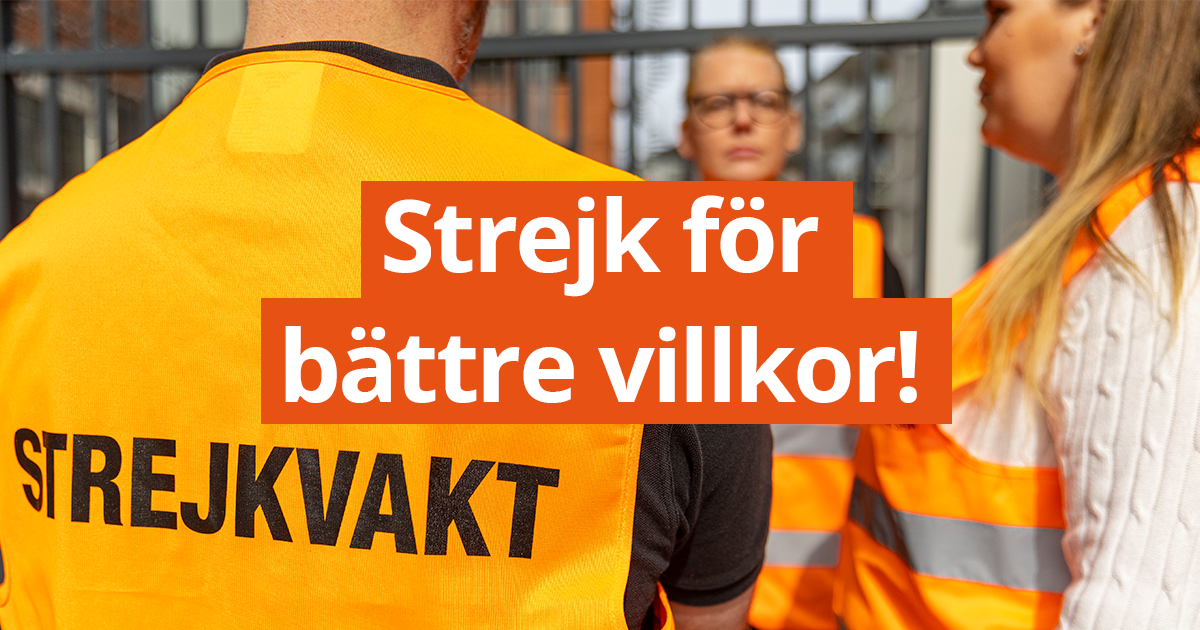
If a situation escalates to the point where a strike is called, members are expected to support and participate in it. This is partly a matter of solidarity with fellow members, but it also protects individual employees from being singled out or blamed by the employer. As an employee, you should be able to say that the decision to strike was made by the union, not by you as an individual.
There are only a few exceptional circumstances in which a member should not participate in a strike, such as when the person is part of the employer’s management team or holds a similar position of responsibility.
Questions and answers about strike
-
What does a strike mean?
During a strike, all Akademikerförbundet SSR members employed at the concerned workplace are included and none of these members should or are allowed to perform any work.
-
Who are entitled to compensation?
All who are members in the union employed at a workplace before a strike breaks out are entitled to full compensation for loss of income. If you are employed at a workplace where a strike breaks out and are not yet a member you can easily apply for membership, but be sure to do it before the strike breaks out.
-
Can I work remotely during the labour market conflict?
No, the strike covers all work, including remote work, via computer, by phone or similar.
-
Am I allowed to work despite being covered be the strike?
If you work despite the strike being in effect, you risk being expelled from the union. According to the statutes of the union, you as a member have an obligation of loyalty towards the union and to respect the decisions that the union might make regarding, for instance, industrial action.
A member who does not go on strike despite being included will most likely be deemed disloyal to the union and be expelled. Before such measures are taken, the member who is suggested to be expelled shall be offered an opportunity to voice their opinion on the matter.
-
Is anyone exempted during a labour market conflict?
Which white-collar employees who might be exempted from the industrial action is determined by the union. The Managing Director, Deputy Managing Director, Assistant to the Managing Director and Head of Human Resources are normally exempted, together with white-collar employees on annual leave, compensatory leave, serving abroad or serving as a company board representative on behalf of the union.
Until any exemptions are applied, you are still covered by the industrial action. During any time when you are not covered by the industrial action, you receive regular pay from the company. If you have questions on if you are going to be exempted or ask to be exempted send an email to dispens@akademssr.se.
The employer must also apply for exemptions from the union.
-
Can an employer hire consultants and contractors during a labour market conflict?
A strike always means a ban on the hiring of new consultants and contractors in order to replace a member who is a part of the labour market conflict. It also means a ban on expanding the existing consultants and contractors’ current assignments.
-
What does the strike pay amount to?
You receive full compensation starting from the first day a strike or lockout is put in effect.
-
What is compensated?
The loss of income covered is for fixed salary, fixed salary supplements and variable pay. The value of any variable pay is based on the average sum during the latest 12-month period of any commission, salary incentives etc. The value of benefits, for example the regular use of a car provided by the company that has not been able to be used during the labour market conflict, is also covered. You can also be compensated, for example, for sick pay and parental pay that has been withheld due to the labour market conflict.
-
Do I pay statutory tax on my strike pay?
No, strike pay is exempted from tax and is therefore paid out net which therefore shall correspond to the actual loss of income after tax calculated on the entire fiscal year. We calculate the compensation on a standardized basis (which is the same for everyone) following the Swedish Tax Agency’s (Skatteverkets) tax table 32.
-
How do I apply for strike pay?
You apply for strike pay via SSR's website. Under My Pages you'll find the link to what's called Uppdragsredovisning ("Assignment Reporting"). That's the module where you apply for strike pay. Additional information on how to apply for conflict compensation will be sent out in due course. The aim is for you to receive the strike pay before the employer makes the pay deduction.
-
Can a new member receive strike pay?
If the application for membership has reached the central office at the latest when the labour market conflict breaks out (i.e. when the strike is put in effect), you can receive strike pay.
-
On parental leave or on garden leave with retained salary?
If the employer stops paying your salary/parental pay and refers to the labour market conflict, you can apply for strike pay from the union to cover the loss of income.
-
Occupational pension contributions during the strike period?
The employer is not obligated to pay towards your occupational pension during a labour market conflict. This can mean that no contributions are made towards your occupational pension. The main principle is “full compensation” when participating in a labour market conflict. Loss of pension contributions, however, cannot be compensated on a standardized basis when paying out the immediate strike pay, since the loss of contributions that might occur for some members will not be visible until later.
-
Which insurances continue to apply during a strike?
All members that are included in the strike are covered by an accident insurance if something were to happen during the time the strike is in effect, provided you are not covered by your own accident insurance. If you work as a picket or carry out other assignments for the union during the strike you are also insured.
-
Am I allowed to strike if I work on a work permit?
Yes. In Sweden, people with a work permit have the same basic right to take part in a lawful strike as any other worker in the labor market. Taking part in industrial action does not affect the validity of your work permit, provided that the basic conditions for the permit continue to be met over time.
-
Can the employer take countermeasures (e.g. a lockout), and what would that mean for me?
Yes, the employer is legally entitled to respond to a strike with a lockout – that is, to shut employees out of the workplace and withhold their pay during the conflict – in the same way the union is entitled to give notice of a strike. A lockout must be announced in the same way as other industrial actions, so it cannot happen from one day to the next without warning.
If the employer were to respond with a lockout, in practice it would mean that you, if locked out, are not permitted to carry out your work and do not receive pay from the employer for as long as the lockout lasts, regardless of whether you yourself are participating in the strike. You may instead be entitled to strike pay from the union, on the same terms as during a strike. Your employment is otherwise not affected as such – a lockout is a temporary industrial action, not a dismissal, and once the conflict is resolved you return to your normal work on your normal terms.